GET RSS DOPE


 Posts
All Comments
Posts
All Comments
Showing posts with label SOCIAL MOOD. Show all posts
Showing posts with label SOCIAL MOOD. Show all posts
Monday, April 4, 2011


Tuesday, February 22, 2011
The Great American Mortgage Ponzi scheme.
For the last 30 years, the economic growth has gone to the top one-hundredth of one percent, who now make an average of 27 million per household, the average income for the bottom 90% of us? $31,244.
The 80/20 rule, I conclude, resolves that the path of least resistance transfers the most amount of resources into the management of relatively few.
What I am about to write, they will not like.
Until now, the possibility of more people being able to have more resources seemed impossible. Yet, there is the possibility the world's resources at large could be transferred to more of the 90% of us.
My observations brought me down a road....
...where it was citizens throughout the nation and perhaps even the globe, which are being unknowingly exploited by plutocrats at the expense of humankind's freedom and domestic currency inflation.
Exploitations that I find go beyond the normal course of business. Taking candy from a baby is unacceptable.
The Ponzi Scheme
Building an entire industry around this matter in the form of multilevel marketing schemes where existing groups require the financial support of the larger group after them, ultimately a Ponzi scheme,
- weakens our markets,
- builds unrealistic ideals, and
- ultimately ruins entire civilizations.
Unless we as a society want to find ourselves slaves, we cannot allow the bloodshed of our forefathers to be slowly formed into a monarchy.
Friday, December 31, 2010
2010 Recap: Macro Trends Playing Out as Expected with Some Surprises...
From Mike Krieger of KAM LP
Macro Themes for 2011
Heading into 2010 I focused on three investment areas that I thought would benefit the most from the insane policies of desperate global Central Banks and governments adhering to the orders of the financial oligarchs that control them. They were to be long precious metals, agricultural commodities and oil. Not only was I a believer that most globally traded “hard assets” (as opposed to residential real estate) would do well as global fiat currencies are competitively devalued, but I thought that the three subgroups mentioned above would do particularly well since they are also strategic commodities. Basically, in a world going through the type of dangerous geopolitical shift we are in at the moment (these happen once in a generation and are called “Fourth Turnings” by Neil Howe and William Strauss) governments and in fact all institutions become subject to upheaval and revolution. Since governments are made up of human beings (generally narcissistic power hungry ones) we can generally forecast how they will react to such tension. In their attempt to maintain power and status governments usually do one of two things. They turn on their own people (or minorities within their own societies) or they turn the anger of the populace on a foreign enemy. In an environment where the global financial system is based on digital monopoly money created with a keystroke by Banana Ben and company, money itself will become suspect and any large foreign government with even a basic understanding of money matters will buy all the gold they can so that if necessary they have real money to use the basis for a new currency if necessary down the road. Just as gold is a necessary hedge for individual Americans that can see the destruction of currency values by their own government, it is too a hedge for China, Russia and others against their U.S. dollar reserve assets and indeed the global financial system to which they are a major participant. Agricultural commodities are just as important since if a nation like China cannot provide food at a reasonable cost to its citizens there will be revolution overnight. In fact , this is true in any nation. Oil fits in to the equation as a hedge if the whole thing breaks into global warfare which can occur once a nation loses the financial war happening now. If you don’t have access to enough oil you will lose any major conflict. Why do you think we are in the Middle East and are looking for an excuse to attack Iran? To spread Democracy? Don’t make me laugh.
There were two things that surprised me this past year. First, was the effectiveness of propaganda and market manipulation. Despite, the obvious lack of any real economic recovery other than phony aggregate demand increases due to inflationary policies many people actually think things are getting better. The Larry Summers’ of the world and other economic magicians like him have one economic policy and that is expectations management, which really means create enough propaganda, push the stock market up, and people will then believe things are getting better and then things will get better in reality. I believe this policy has been half successful so far. It has been successful is kicking the can down the road but it has not been and will not be successful in improving the standards of living for the American people and it is becoming more and more widely understood that this “respite” is merely being used by the small oligarch class in Washington D.C. and Wall Street to steal what little is left and push the middle class into serfdom. When this thing collapses again let’s never lose sight of this and remember who did what during these days of “recovery.”
The second thing that surprised me was the strong performance of consumer discretionary stocks and retail in general. I think the main thing that caused this particular group to perform so much better than expected in 2010 was the fact that crude remained range-bound for most of it. It is really only in the past couple of months that crude has broken out of its range. I think mature retail companies will be amongst the worst performing groups in 2011 and I will explain why in the section below.
2011: Back to the Basics (Again)
Just like the political world has been divided into two fake categories to keep us peasants in a controllable paradigm (Democratic/Republican, Red Team/Blue Team nonsense), it seems as if the investment world is similarly divided into China Bulls or U.S. Bulls. There is this idea that one nation is doing things so much better than the other and there will be this big winner to emerge. I hate to break it to everyone but there will be no winner in the intermediate term. The entire global economy is linked in a gigantic financial ponzi scheme based on a completely worthless reserve asset (the U.S. dollar) and none of the players will be able to extricate themselves from this easily. This is precisely why China has not allowed the yuan to strengthen materially. There is one reason and one reason alone for this. The government is terrified beyond belief of the near-term consequences of this since their only objective in reality is to maintain power. As a result, it is not just the U.S. that is digging themselves into a disastrous position but it is indeed much of the entire world.
The strategy of the Keynesian economic magicians in control of the levers of finance globally has been to stimulate artificial aggregate demand via a number of policies, the central component of which is buying worthless assets with equally worthless paper. Why not! In any event, of course this succeeds in boosting aggregate demand as it has since 2009. The problem is if the demand represents “malinvestments” based on phony signals what you end up with is pure inflation and no real increase in standards of living. This is manifesting itself in different ways in different countries like China and the U.S. but it is manifesting itself in one important way in both. The widening gap between rich and poor. This is becoming an enormous problem in both countries which is why in Beijing they recently announced a plan to raise the minimum wage next year by 21%, which is the second such increase in the past six months. How about this quote from the FT on Tuesday:
“In just the last three months we’ve already had to raise entry-level starting wages 60 per cent just to get people to come to a job interview,” said Jade Gray, chief executive of Gung Ho Pizza, a Beijing-based gourmet pizza delivery service. “With rising rents, the much higher cost of ingredients and now wage inflation, many businesses in the services industries are going to find it impossible not to pass on much higher costs to consumers.”
People in the U.S. think there is no inflation because wage growth has been subdued and because they still believe the most manipulated statistic in world history, the “core” CPI. Here in America, purchasing power has been maintained through transfer payments and extending unemployment insurance. The most disgusting thing about all of this is that Washington D.C. comes out and pretends to be heroes by doing this. Oh yeah, continuing to give people the same amount of money for more expensive bread while they rob you blind. That’s some leadership.
It’s Falling Apart as We Speak
As I read stories recently about China reducing supplies for rare earths, I watched oil and grains skyrocket to new highs I couldn’t help but think to myself: “we are going back to real trade again.” What I mean is that the prices for all the real “stuff” that at the end of the day makes the world go round are still in the early stages of being revalued to a realistic level. We want China’s rare earths, they want our grains. Ok, we can probably make a deal there. Despite what they may say publicly no one wants dollars and neither should you. We are still in the middle of a secular bull market in commodities. In times like these real assets that were grossly undervalued relative to financial assets in the prior secular bull become revalued. Money also becomes revalued. We are still working off the bubble in financial assets and the bubble in fiat currencies (especially the dollar) that popped in 2000. It will be over when the Dow Industrials = the price of gold wherever that may be. It is still 8:1. It reached about 1:1 in both the 1930s and the late 1970s. In terms of gold the S&P500 was down 12% this year. Pathetic.
All of the phony aggregate demand that has been created has now led to the surging commodity prices we are witnessing at the moment. This is a very important signal that must not be ignored. Just as the surge in late 2007-mid 2008 was a huge warning of things to come. It is telling us the current global economic model of GDP growth at all costs is failing. It is telling us we are using up all of the world’s resources without any understanding of sustainable development. The U.S. government is actually encouraging people to buy homes and spend money on trinkets made abroad rather than figure out new sources of energy. We had our window to show real leadership and make the tough decisions and we failed miserably. The Kondratieff winter is knocking on our door and will blow in with reckless abandon in 2011/2012.
This is not to say I am bearish on mankind or the world 10-20 years from now. I am not. I think once we finish the next 5-10 years which could be very, very difficult we can emerge into a New Renaissance. We just need to clean out the trash first. That means the current group of political and economic leaders that have infected the global economy. My advice remains the same. You must accept the fact that the current model has failed and will be replaced. This is why I am so bearish on retail. The business model for too many of them is based on sourcing cheap goods abroad and selling them here. Those days are over. They are over because of wage and other inflation in China and the business model will also be slammed by the cost of shipping things once oil breaches $100/b again, which I expect in early 2011. Precious metals, agriculture and oil remain my favorite themes.
The War on Terror Sham
I witnessed 9/11 in person and it had a huge impact on me emotionally. For a while it blinded me to the ways the government was using the war on terror against its own people. After many years of deep introspection and not jumping to any quick conclusions I unfortunately have come to the conclusion that the war on terror is a sham. This isn’t to say there aren’t real risks of terrorism. There are. There are also real risks to life in general. It is risky to drive a car. It is risky to go skiing. It is risky to live in a big city. That said, once a society trades freedom for safety it is finished. Pigs are safe in their pens too as are all livestock being prepared for slaughter.
What I am saying is that I think the “war on terror” is being used to generate fear in the hearts of unsuspecting citizens so that the government can put in a police state. The top levels of intelligence understand what is to come in the economy and are desperate to put in the police state grid at all costs. I am not telling anyone what to think on this matter. I am only asking you TO THINK. The fate of the nations depend on it. The following was posted on Zerohedge last week but many on my email list may not have seen it. Please read and think about the implications of this…
Two very important articles came out last week that you must take the time to read thoroughly. The first is from the Washington Post and is entitled: “Monitoring America.” It is a lengthy article worth your time since it shows in no uncertain terms how the U.S. government has now officially started to turn war on terror technology and military weaponry on AMERICAN CITIZENS domestically. Stuff that had formerly only been “used in Iraq or Afghanistan” is now being turned on Americans and this newspaper reports it in a matter of fact manner. It also describes how anyone can just say that they think a fellow citizen is acting suspiciously and then all of a sudden the government’s “fusion centers” start snooping on you and a file remains “open” for five years. For nothing more than someone saying they thought you were acting suspiciously. Welcome to East Germany. This is where tax dollars are going, that and to pay bankster bonuses. Link is below.
http://projects.washingtonpost.com/top-secret-america/articles/monitoring-america/?hpid=topnews
Second article also encompasses and interview with Attorney General Eric Holder. In it he clearly explains that enemy number one is the domestic America citizen and that is where the war on terror is now focused. This is exactly as I predicted earlier this year. That the “war on terror” would be soon reversed onto average everyday citizens. So how about this one. In the interview, Holder talks about Anwar al-Awlaki and talks about how this guy is enemy number 1 now and as dangerous as Bin Laden. Well, interesting because this guy was invited to DINE AT THE PENTAGON after 9/11. This is a fact. It was reported by all the mainstream news sources. See these links on it….
Anwar al-Awlaki - the radical spiritual leader linked to several 9/11 attackers, the Fort Hood shooting, and the attempted Christmas Day bombing of an airliner - was a guest at the Pentagon in the months after 9/11, a Pentagon official confirmed to CBS News.
Awlaki was invited as "...part of an informal outreach program" in which officials sought contact "...with leading members of the Muslim community," the official said. At that time, Awlaki was widely viewed as a "moderate" imam at a mosque in Northern Virginia.
This is what Holder said today about him: "He's an extremely dangerous man. He has shown a desire to harm the United States, a desire to strike the homeland of the United States," Holder said. "He is a person who -- as an American citizen -- is familiar with this country and he brings a dimension, because of that American familiarity, that others do not."
CBS reports
http://www.cbsnews.com/stories/2010/10/21/national/main6978200.shtml
MSNBC reports
http://www.msnbc.msn.com/id/39768584/ns/us_news-security/
Fox News Reports
http://www.foxnews.com/us/2010/10/20/al-qaeda-terror-leader-dined-pentagon-months/
So our government is so trustworthy on intelligence that we had the most dangerous terrorist in the world over for dinner at the Pentagon! So either we are really retarded beyond belief or the whole “WAR ON TERROR” is a total SHAM to place in the police state. More on the interview with Holder, he is consistently demonizing the internet with statements like.
“"The ability to go into your basement, turn on your computer, find a site that has this kind of hatred spewed ... they have an ability to take somebody who is perhaps just interested, perhaps just on the edge, and take them over to the other side," he said.”
Full article here: http://abcnews.go.com/Politics/attorney-general-eric-holders-blunt-warning-terror-attacks/story?id=12444727&page=1
This is all good news and bad news. The good news is that the global plantation owners would not be moving so aggressively unless they were losing the info war. Clearly they are, which is why they are freaking out. The next thing that is likely to happen is a false flag attack where the “attacker” ends up being a libertarian with a Ron Paul sticker. That way they can move from Al Awlaki to the folks they are really afraid of: Good caring and armed American people that still have the capacity to think rationally.
Final Thought
It is snowing outside my window right now. The weather out here on the Colorado foothills is really interesting. It is either sunny or it is snowing. It never seems to just be “gray.” It’s really distinct from the weather back in New York and it fits my personality well. Despite all the hardships we face, life is beautiful and good and it is all about embracing great people and experiences. I wish everyone a happy, safe and prosperous 2011.
Below is a link to a video that uses the full song whose lyrics I quoted at the top. This is not a political video in that it is not endorsing either major party. Bush and Obama make me want to vomit with equal vigor. I have no patience for fake Messiahs. It’s just a great song.
http://www.youtube.com/watch?v=dqeK_dnPDHQ&feature=related
Signing off on 2010 from Colorado,
Mike
Macro Themes for 2011
Death may come invisible, or in the holy wall of fire
In the breath between the markers, or on some black I-80 mile
From the madness of the government, to the vengeance of the sea
Everything is eclipsed by the shape of destiny
- Conor Oberst/Bright Eyes, No One Would Riot for Less
2010 Recap: Macro Trends Playing Out as Expected with Some Surprises...In the breath between the markers, or on some black I-80 mile
From the madness of the government, to the vengeance of the sea
Everything is eclipsed by the shape of destiny
- Conor Oberst/Bright Eyes, No One Would Riot for Less
Heading into 2010 I focused on three investment areas that I thought would benefit the most from the insane policies of desperate global Central Banks and governments adhering to the orders of the financial oligarchs that control them. They were to be long precious metals, agricultural commodities and oil. Not only was I a believer that most globally traded “hard assets” (as opposed to residential real estate) would do well as global fiat currencies are competitively devalued, but I thought that the three subgroups mentioned above would do particularly well since they are also strategic commodities. Basically, in a world going through the type of dangerous geopolitical shift we are in at the moment (these happen once in a generation and are called “Fourth Turnings” by Neil Howe and William Strauss) governments and in fact all institutions become subject to upheaval and revolution. Since governments are made up of human beings (generally narcissistic power hungry ones) we can generally forecast how they will react to such tension. In their attempt to maintain power and status governments usually do one of two things. They turn on their own people (or minorities within their own societies) or they turn the anger of the populace on a foreign enemy. In an environment where the global financial system is based on digital monopoly money created with a keystroke by Banana Ben and company, money itself will become suspect and any large foreign government with even a basic understanding of money matters will buy all the gold they can so that if necessary they have real money to use the basis for a new currency if necessary down the road. Just as gold is a necessary hedge for individual Americans that can see the destruction of currency values by their own government, it is too a hedge for China, Russia and others against their U.S. dollar reserve assets and indeed the global financial system to which they are a major participant. Agricultural commodities are just as important since if a nation like China cannot provide food at a reasonable cost to its citizens there will be revolution overnight. In fact , this is true in any nation. Oil fits in to the equation as a hedge if the whole thing breaks into global warfare which can occur once a nation loses the financial war happening now. If you don’t have access to enough oil you will lose any major conflict. Why do you think we are in the Middle East and are looking for an excuse to attack Iran? To spread Democracy? Don’t make me laugh.
There were two things that surprised me this past year. First, was the effectiveness of propaganda and market manipulation. Despite, the obvious lack of any real economic recovery other than phony aggregate demand increases due to inflationary policies many people actually think things are getting better. The Larry Summers’ of the world and other economic magicians like him have one economic policy and that is expectations management, which really means create enough propaganda, push the stock market up, and people will then believe things are getting better and then things will get better in reality. I believe this policy has been half successful so far. It has been successful is kicking the can down the road but it has not been and will not be successful in improving the standards of living for the American people and it is becoming more and more widely understood that this “respite” is merely being used by the small oligarch class in Washington D.C. and Wall Street to steal what little is left and push the middle class into serfdom. When this thing collapses again let’s never lose sight of this and remember who did what during these days of “recovery.”
The second thing that surprised me was the strong performance of consumer discretionary stocks and retail in general. I think the main thing that caused this particular group to perform so much better than expected in 2010 was the fact that crude remained range-bound for most of it. It is really only in the past couple of months that crude has broken out of its range. I think mature retail companies will be amongst the worst performing groups in 2011 and I will explain why in the section below.
2011: Back to the Basics (Again)
Just like the political world has been divided into two fake categories to keep us peasants in a controllable paradigm (Democratic/Republican, Red Team/Blue Team nonsense), it seems as if the investment world is similarly divided into China Bulls or U.S. Bulls. There is this idea that one nation is doing things so much better than the other and there will be this big winner to emerge. I hate to break it to everyone but there will be no winner in the intermediate term. The entire global economy is linked in a gigantic financial ponzi scheme based on a completely worthless reserve asset (the U.S. dollar) and none of the players will be able to extricate themselves from this easily. This is precisely why China has not allowed the yuan to strengthen materially. There is one reason and one reason alone for this. The government is terrified beyond belief of the near-term consequences of this since their only objective in reality is to maintain power. As a result, it is not just the U.S. that is digging themselves into a disastrous position but it is indeed much of the entire world.
The strategy of the Keynesian economic magicians in control of the levers of finance globally has been to stimulate artificial aggregate demand via a number of policies, the central component of which is buying worthless assets with equally worthless paper. Why not! In any event, of course this succeeds in boosting aggregate demand as it has since 2009. The problem is if the demand represents “malinvestments” based on phony signals what you end up with is pure inflation and no real increase in standards of living. This is manifesting itself in different ways in different countries like China and the U.S. but it is manifesting itself in one important way in both. The widening gap between rich and poor. This is becoming an enormous problem in both countries which is why in Beijing they recently announced a plan to raise the minimum wage next year by 21%, which is the second such increase in the past six months. How about this quote from the FT on Tuesday:
“In just the last three months we’ve already had to raise entry-level starting wages 60 per cent just to get people to come to a job interview,” said Jade Gray, chief executive of Gung Ho Pizza, a Beijing-based gourmet pizza delivery service. “With rising rents, the much higher cost of ingredients and now wage inflation, many businesses in the services industries are going to find it impossible not to pass on much higher costs to consumers.”
People in the U.S. think there is no inflation because wage growth has been subdued and because they still believe the most manipulated statistic in world history, the “core” CPI. Here in America, purchasing power has been maintained through transfer payments and extending unemployment insurance. The most disgusting thing about all of this is that Washington D.C. comes out and pretends to be heroes by doing this. Oh yeah, continuing to give people the same amount of money for more expensive bread while they rob you blind. That’s some leadership.
It’s Falling Apart as We Speak
As I read stories recently about China reducing supplies for rare earths, I watched oil and grains skyrocket to new highs I couldn’t help but think to myself: “we are going back to real trade again.” What I mean is that the prices for all the real “stuff” that at the end of the day makes the world go round are still in the early stages of being revalued to a realistic level. We want China’s rare earths, they want our grains. Ok, we can probably make a deal there. Despite what they may say publicly no one wants dollars and neither should you. We are still in the middle of a secular bull market in commodities. In times like these real assets that were grossly undervalued relative to financial assets in the prior secular bull become revalued. Money also becomes revalued. We are still working off the bubble in financial assets and the bubble in fiat currencies (especially the dollar) that popped in 2000. It will be over when the Dow Industrials = the price of gold wherever that may be. It is still 8:1. It reached about 1:1 in both the 1930s and the late 1970s. In terms of gold the S&P500 was down 12% this year. Pathetic.
All of the phony aggregate demand that has been created has now led to the surging commodity prices we are witnessing at the moment. This is a very important signal that must not be ignored. Just as the surge in late 2007-mid 2008 was a huge warning of things to come. It is telling us the current global economic model of GDP growth at all costs is failing. It is telling us we are using up all of the world’s resources without any understanding of sustainable development. The U.S. government is actually encouraging people to buy homes and spend money on trinkets made abroad rather than figure out new sources of energy. We had our window to show real leadership and make the tough decisions and we failed miserably. The Kondratieff winter is knocking on our door and will blow in with reckless abandon in 2011/2012.
This is not to say I am bearish on mankind or the world 10-20 years from now. I am not. I think once we finish the next 5-10 years which could be very, very difficult we can emerge into a New Renaissance. We just need to clean out the trash first. That means the current group of political and economic leaders that have infected the global economy. My advice remains the same. You must accept the fact that the current model has failed and will be replaced. This is why I am so bearish on retail. The business model for too many of them is based on sourcing cheap goods abroad and selling them here. Those days are over. They are over because of wage and other inflation in China and the business model will also be slammed by the cost of shipping things once oil breaches $100/b again, which I expect in early 2011. Precious metals, agriculture and oil remain my favorite themes.
The War on Terror Sham
I witnessed 9/11 in person and it had a huge impact on me emotionally. For a while it blinded me to the ways the government was using the war on terror against its own people. After many years of deep introspection and not jumping to any quick conclusions I unfortunately have come to the conclusion that the war on terror is a sham. This isn’t to say there aren’t real risks of terrorism. There are. There are also real risks to life in general. It is risky to drive a car. It is risky to go skiing. It is risky to live in a big city. That said, once a society trades freedom for safety it is finished. Pigs are safe in their pens too as are all livestock being prepared for slaughter.
What I am saying is that I think the “war on terror” is being used to generate fear in the hearts of unsuspecting citizens so that the government can put in a police state. The top levels of intelligence understand what is to come in the economy and are desperate to put in the police state grid at all costs. I am not telling anyone what to think on this matter. I am only asking you TO THINK. The fate of the nations depend on it. The following was posted on Zerohedge last week but many on my email list may not have seen it. Please read and think about the implications of this…
Two very important articles came out last week that you must take the time to read thoroughly. The first is from the Washington Post and is entitled: “Monitoring America.” It is a lengthy article worth your time since it shows in no uncertain terms how the U.S. government has now officially started to turn war on terror technology and military weaponry on AMERICAN CITIZENS domestically. Stuff that had formerly only been “used in Iraq or Afghanistan” is now being turned on Americans and this newspaper reports it in a matter of fact manner. It also describes how anyone can just say that they think a fellow citizen is acting suspiciously and then all of a sudden the government’s “fusion centers” start snooping on you and a file remains “open” for five years. For nothing more than someone saying they thought you were acting suspiciously. Welcome to East Germany. This is where tax dollars are going, that and to pay bankster bonuses. Link is below.
http://projects.washingtonpost.com/top-secret-america/articles/monitoring-america/?hpid=topnews
Second article also encompasses and interview with Attorney General Eric Holder. In it he clearly explains that enemy number one is the domestic America citizen and that is where the war on terror is now focused. This is exactly as I predicted earlier this year. That the “war on terror” would be soon reversed onto average everyday citizens. So how about this one. In the interview, Holder talks about Anwar al-Awlaki and talks about how this guy is enemy number 1 now and as dangerous as Bin Laden. Well, interesting because this guy was invited to DINE AT THE PENTAGON after 9/11. This is a fact. It was reported by all the mainstream news sources. See these links on it….
Anwar al-Awlaki - the radical spiritual leader linked to several 9/11 attackers, the Fort Hood shooting, and the attempted Christmas Day bombing of an airliner - was a guest at the Pentagon in the months after 9/11, a Pentagon official confirmed to CBS News.
Awlaki was invited as "...part of an informal outreach program" in which officials sought contact "...with leading members of the Muslim community," the official said. At that time, Awlaki was widely viewed as a "moderate" imam at a mosque in Northern Virginia.
This is what Holder said today about him: "He's an extremely dangerous man. He has shown a desire to harm the United States, a desire to strike the homeland of the United States," Holder said. "He is a person who -- as an American citizen -- is familiar with this country and he brings a dimension, because of that American familiarity, that others do not."
CBS reports
http://www.cbsnews.com/stories/2010/10/21/national/main6978200.shtml
MSNBC reports
http://www.msnbc.msn.com/id/39768584/ns/us_news-security/
Fox News Reports
http://www.foxnews.com/us/2010/10/20/al-qaeda-terror-leader-dined-pentagon-months/
So our government is so trustworthy on intelligence that we had the most dangerous terrorist in the world over for dinner at the Pentagon! So either we are really retarded beyond belief or the whole “WAR ON TERROR” is a total SHAM to place in the police state. More on the interview with Holder, he is consistently demonizing the internet with statements like.
“"The ability to go into your basement, turn on your computer, find a site that has this kind of hatred spewed ... they have an ability to take somebody who is perhaps just interested, perhaps just on the edge, and take them over to the other side," he said.”
Full article here: http://abcnews.go.com/Politics/attorney-general-eric-holders-blunt-warning-terror-attacks/story?id=12444727&page=1
This is all good news and bad news. The good news is that the global plantation owners would not be moving so aggressively unless they were losing the info war. Clearly they are, which is why they are freaking out. The next thing that is likely to happen is a false flag attack where the “attacker” ends up being a libertarian with a Ron Paul sticker. That way they can move from Al Awlaki to the folks they are really afraid of: Good caring and armed American people that still have the capacity to think rationally.
Final Thought
It is snowing outside my window right now. The weather out here on the Colorado foothills is really interesting. It is either sunny or it is snowing. It never seems to just be “gray.” It’s really distinct from the weather back in New York and it fits my personality well. Despite all the hardships we face, life is beautiful and good and it is all about embracing great people and experiences. I wish everyone a happy, safe and prosperous 2011.
Below is a link to a video that uses the full song whose lyrics I quoted at the top. This is not a political video in that it is not endorsing either major party. Bush and Obama make me want to vomit with equal vigor. I have no patience for fake Messiahs. It’s just a great song.
http://www.youtube.com/watch?v=dqeK_dnPDHQ&feature=related
Signing off on 2010 from Colorado,
Mike
Thursday, October 7, 2010
INTERVIEW: WITH A EURO STOCK OPERATOR
Here we found an interview with a European operator whom runs under 1/2 Billion. My opinion, he has a few too many moving parts, but we still respect your skill. Otherwise why would we bother posting. We are glad you agreed to the interview to help share how the real world works. We stand right there with you in the belief system that will keep others in check
Saturday, October 2, 2010
Global employment will not recover to pre-crisis levels until 2015
Global employment crisis will stir social unrest, warns UN agency
Global employment will not recover to pre-crisis levels until 2015 if current policies are pursued, creating social tension, the International Labour Organisation has warned
Published: 3:16PM BST 30 Sep 2010
Riot police hit out at demonstrators during protests in Barcelona, Spain Photo: AP
The United Nations work agency said it was putting back by two years from 2013 its previous assessment of the time needed to create the 22 million jobs still needed to regain the pre-crisis level - 14 million in rich countries and 8 million in developing states. The global economy has started to grow again with encouraging signs of employment recovery especially in some Asian and Latin American emerging economies, the ILO said in its annual World of Work report.
Despite these significant gains ... new clouds have emerged on the employment horizon and the prospects have worsened significantly in many countries," it said.
Raymond Torres, lead author of the report, told a news conference that job losses since the crisis started had totalled some 30-35 million. The ILO has forecast global unemployment this year of 213 million, a rate of 6.5 per cent.
For the United States - where persistent unemployment has become one of the main issues in this November's elections - the number of jobs still needed to regain pre-crisis levels is 6.9 million, Steven Tobin, ILO economist, said.
The extended loss of employment and growing perceptions of unfairness risked increasing social tension, the ILO said.
In 35 countries for which data exists, nearly 40 per cent of jobseekers have been without work for more than one year, running risks of demoralisation and mental health problems, and young people were disproportionately hit by unemployment.
It noted that social unrest related to the crisis has been reported in at least 25 countries, including some recovering emerging economies.
This week riot police were on the streets as protesters in Spain, Belgium, Italy and Greece demonstrated against tough austerity measures.
In more than three quarters of 82 countries with such information available, peoples' perceptions of their quality of life and standard of living had declined in 2009 from 2006, with job satisfaction also declining even among those in work.
Torres warned governments against withdrawing fiscal stimulus measures while recovery was still weak.
The ILO recommended three policies for a jobs-led recovery:
* A combination of active labour market policies including work-sharing that target vulnerable groups such as young people, and training;
* A closer link between wages and productivity gains in surplus countries to boost demand and job creation;
* Reforms of the financial sector to ensure savings are channelled to productive investment.
Friday, September 10, 2010
The Elites Have Lost The Right to Rule
From Michael Krieger of KAM LP
War is the growth hormone of the cancer that is big government.
- Alex Jones
A government always finds itself obliged to resort to inflationary measures when it cannot negotiate loans and dare not levy taxes, because it has reason to fear that it will forfeit approval of the policy it is following if it reveals too soon the financial and general economic consequences of that policy. Thus inflation becomes the most important psychological resource of any economic policy whose consequences have to be concealed; and so in this sense it can be called an instrument of unpopular, that is, of antidemocratic policy, since by misleading public opinion it makes possible the continued existence of a system of government that would have no hope of the consent of the people if the circumstances were clearly laid before them. That is the political function of inflation. When governments do not think it necessary to accommodate their expenditure and arrogate to themselves the right of making up the deficit by issuing notes, their ideology is merely a disguised absolutism.
- Ludwig von Mises
How Wall Street Died
Let me take you back to the fall of 1999. I was a senior in college without a clue what I wanted to do with my life. Wall Street was in a boom and seemed exciting. I had always loved the financial markets since I had first discovered them years earlier; however, I wasn’t convinced this was the profession I wanted. I had majored in Economics at school for practical purposes but I found almost all of the courses to be extraordinarily uninspiring with the exception of a few like Corporate Finance and the Economic History of China. It was the general micro and macro economics courses that I found the most painful to sit through. I wasn’t alone in this assessment. Many of my close friends were Economics majors as well and we all felt the same way (I later found out this was because we were being indoctrinated in voodoo Keynesian economics) . So even with the Economics degree I wasn’t sure that I wanted to pursue a career in finance given the fact that I found myself more interested in subjects such as English , History and Philosophy. Nevertheless, the firms were hiring, I had the degree and it would allow me to move back to New York City without living at home.
What I discovered as I interviewed for jobs disturbed me right away. Every single firm with the exception of one was completely obsessed with math. Entire interviews revolved around “how quantitative are you” and the like. Although I hadn’t had much experience with investing I had enough to know this line of thinking seemed preposterous. It seemed to me only basic math skills are necessary to be a successful equity investor. Besides that, it seemed that the key is understanding that the world is always changing rapidly under the surface and therefore what is a good business today might be bankrupt tomorrow and what is a start up today could be the next Microsoft. This seems obvious but the skill set to figuring all this out is more geared to an appreciation of human psychology, historical cycles and cultural shifts (both fads and structural changes) than math. What I realized later is the reason they were so focused on mathematicians and Phd’s is that Wall Street was moving away from what it was always meant to be - a conduit between the holders of capital and those that wish to deploy that capital in productive economic activity. Rather than trying to hire a well rounded workforce of intelligent college graduates the firms were hiring a cadre of quantitative robots that would play an instrumental roll in blowing up the world’s financial system.
When you get too many people of a particular mindset (in this case highly quantitative and academic) to aggregate in a field that is very much a people business and one where “street smart” common sense is of extreme importance you are asking for serious trouble. When you couple that with a Federal Reserve that keeps interest rates too low what you get is a bunch of quants inventing products that provide a yield sufficient for pensions and others struggling to earn a return. Products that are completely mispriced for the risk inherent in them. I am not placing all of the blame on the Wall Street firms (although they deserve a lot and the fact people haven’t been punished severely is a huge reason why there is no confidence on main street), rather I believe the Federal Reserve deserves 95% of it. If it wasn’t for them manipulating the price of money to absurdly low levels you wouldn’t have had the rush into toxic products in a search for yield. While the newly enthroned Wall Street quant army would surely have done their damage nonetheless it wouldn’t have resulted in the complete destruction of the financial and monetary system that we face today. In a nutshell, this is how I think Wall Street died and until it gets its act together will remain a corpse.
The Elites Have Lost Their Right to Rule
What I discovered as I interviewed for jobs disturbed me right away. Every single firm with the exception of one was completely obsessed with math. Entire interviews revolved around “how quantitative are you” and the like. Although I hadn’t had much experience with investing I had enough to know this line of thinking seemed preposterous. It seemed to me only basic math skills are necessary to be a successful equity investor. Besides that, it seemed that the key is understanding that the world is always changing rapidly under the surface and therefore what is a good business today might be bankrupt tomorrow and what is a start up today could be the next Microsoft. This seems obvious but the skill set to figuring all this out is more geared to an appreciation of human psychology, historical cycles and cultural shifts (both fads and structural changes) than math. What I realized later is the reason they were so focused on mathematicians and Phd’s is that Wall Street was moving away from what it was always meant to be - a conduit between the holders of capital and those that wish to deploy that capital in productive economic activity. Rather than trying to hire a well rounded workforce of intelligent college graduates the firms were hiring a cadre of quantitative robots that would play an instrumental roll in blowing up the world’s financial system.
When you get too many people of a particular mindset (in this case highly quantitative and academic) to aggregate in a field that is very much a people business and one where “street smart” common sense is of extreme importance you are asking for serious trouble. When you couple that with a Federal Reserve that keeps interest rates too low what you get is a bunch of quants inventing products that provide a yield sufficient for pensions and others struggling to earn a return. Products that are completely mispriced for the risk inherent in them. I am not placing all of the blame on the Wall Street firms (although they deserve a lot and the fact people haven’t been punished severely is a huge reason why there is no confidence on main street), rather I believe the Federal Reserve deserves 95% of it. If it wasn’t for them manipulating the price of money to absurdly low levels you wouldn’t have had the rush into toxic products in a search for yield. While the newly enthroned Wall Street quant army would surely have done their damage nonetheless it wouldn’t have resulted in the complete destruction of the financial and monetary system that we face today. In a nutshell, this is how I think Wall Street died and until it gets its act together will remain a corpse.
The Elites Have Lost Their Right to Rule
One of my favorite quotes is from Joseph Schumpeter who said “everyone has elites the important thing is to change them from time to time.” Of course, this is what happens in a well functioning democracy. The problem today and the reason why the United States is on the verge of some sort of revolution (I believe it will manifest as a revolution of ideas and not an armed one) is that the election of Obama has proven to everyone watching with an unbiased eye that no matter who the President is they continue to prop up an elite at the top that has been running things into the ground for years. The appointment of Larry Summers and Tiny Turbo-Tax Timmy Geithner provided the most obvious sign that something was seriously not kosher. Then there was the reappointment of Ben Bernanke. While the Republicans like to simplify him as merely a socialist he represents something far worse.
Of course it is not just Obama. He is at the end of a long line of Presidents that think they have some sort of divine right of kings to rule. Think about the Presidency of the United States since 1988. Bush, Clinton, Bush…If Obama had not won the Democratic primary we would have ended up with President Hilary Clinton. Catch my drift? Something is not right here. This is the United States not some sort of petty monarchy. There is no divine right of any family or group of families to rule. When this starts to happen you get the disaster we are now faced with. That said, the bigger point is this. What Obama has attempted to do is to wipe a complete economic collapse under the rug and maintain the status quo so that the current elite class in the United States remains in control. The “people” see this ploy and are furious. Those that screwed up the United States economy should never make another important decision about it yet they remain firmly in control of policy. The important thing in any functioning democracy is the turnover of the elite class every now and again. Yet, EVERY single government policy has been geared to keeping that class in power and to pass legislation that gives the Federal government more power to then buttresses this power structure down the road. This is why Obama is so unpopular. Everything else is just noise to keep people divided and distracted.
Getting Into the Mind of Ben Bernanke
Of course it is not just Obama. He is at the end of a long line of Presidents that think they have some sort of divine right of kings to rule. Think about the Presidency of the United States since 1988. Bush, Clinton, Bush…If Obama had not won the Democratic primary we would have ended up with President Hilary Clinton. Catch my drift? Something is not right here. This is the United States not some sort of petty monarchy. There is no divine right of any family or group of families to rule. When this starts to happen you get the disaster we are now faced with. That said, the bigger point is this. What Obama has attempted to do is to wipe a complete economic collapse under the rug and maintain the status quo so that the current elite class in the United States remains in control. The “people” see this ploy and are furious. Those that screwed up the United States economy should never make another important decision about it yet they remain firmly in control of policy. The important thing in any functioning democracy is the turnover of the elite class every now and again. Yet, EVERY single government policy has been geared to keeping that class in power and to pass legislation that gives the Federal government more power to then buttresses this power structure down the road. This is why Obama is so unpopular. Everything else is just noise to keep people divided and distracted.
Getting Into the Mind of Ben Bernanke
I do not have a clear window into the highest levels of power in many areas such as the military or the intelligence community but I do have a very good understanding of it when it comes to the financial system and the economy. At the end of the day everyone knows that those who can create the money and credit have the ultimate power over any political system. Therefore, at the top of the economic power of the world is the Federal Reserve and at the top of that is Ben Bernanke. This is why I took a great deal of interest in reading the full text of his speech today. Much will be written about it but I want to tackle it from two points. First, who is Ben Bernanke?
You can really see into his head from reading this speech. He is an academic who thinks he is smarter than everyone else which is why he is in the position he is in. He thinks the key to monetary policy is to trick people into doing things that will hurt them in the end. He believes the mal-investments he intends to push people and institutions into equals economic growth. What surprises me so much about the investment community and the American public in general is that so many fail to understand that we live in a top down centralized economic system much more similar to China in more ways than people want to admit. We look at how the government steers the economy in China and sneer. How are we so different right now?
As far as the speech itself, it confirms something I mentioned several weeks ago. Banana Ben absolutely wants to do a massive QE2 program. The only thing holding him back is gold is near an all time high. What he wants is gold much lower and stocks much lower to give him cover. Gold has not cooperated so he is in a bind. He cannot print a massive amount of money with gold here and stocks at 1055 because what happens if gold soars and stocks sell-off in the days that follow such an announcement? What if the response in the treasury market is not as desired? He is scared to do it here and he is right to be scared because such a reaction would be the end of the Fed right then and there. The Fed will be gone anyway within a few years in my opinion but it’s going to fight hard to survive and if you want to make money in this market you need to understand that. The most powerful institution in the world is fighting for its survival. Never forget that.
So what is he going to do? I believe that the Fed and government are doing a lot more than people think to manipulate all markets behind the scenes. After all, they have publicly announced their manipulation in many other ways so does it make any sense whatsoever to assume they aren’t doing a plethora of other things behind the scenes? Of course not. I think that with the Fed in a bind they will accelerate and become ever more aggressive in behind the scenes games. This will make markets even more volatile and extraordinarily challenging. This is financial war make no mistake about it. The only way in my opinion to survive this is to buy all dips in precious metals, agriculture and oil. It is in these three areas that I expect to see the most price inflation as money eventually figures out the end game. The end game is more and more people will eventually wake up to the fact that the markets are a hologram put in front of you by the magicians at the Fed. That what constitutes real wealth in the years ahead will be owning food, energy and a means of exchange that will be accepted should a black market economy arise as it has in virtually all nations at one time or another throughout history.
In the end, the elites will be overthrown and a power vacuum will form. The transition period will be extremely difficult as the elites will fight their demise to the end. For you see, they care nothing for you they care about their power and control. Nevertheless, rulers have always only ruled by the will (or apathy) of the people and when the people become overly taxed and abused they always rebel. The main thing to think about is what kind of society do we want to rebuild from the ashes. I am of the view that it must be a return to the Constitution and an elimination of central banking power and secrecy. Let’s not fall for a demagogue or be pushed into a war when things are at their worst.
You can really see into his head from reading this speech. He is an academic who thinks he is smarter than everyone else which is why he is in the position he is in. He thinks the key to monetary policy is to trick people into doing things that will hurt them in the end. He believes the mal-investments he intends to push people and institutions into equals economic growth. What surprises me so much about the investment community and the American public in general is that so many fail to understand that we live in a top down centralized economic system much more similar to China in more ways than people want to admit. We look at how the government steers the economy in China and sneer. How are we so different right now?
As far as the speech itself, it confirms something I mentioned several weeks ago. Banana Ben absolutely wants to do a massive QE2 program. The only thing holding him back is gold is near an all time high. What he wants is gold much lower and stocks much lower to give him cover. Gold has not cooperated so he is in a bind. He cannot print a massive amount of money with gold here and stocks at 1055 because what happens if gold soars and stocks sell-off in the days that follow such an announcement? What if the response in the treasury market is not as desired? He is scared to do it here and he is right to be scared because such a reaction would be the end of the Fed right then and there. The Fed will be gone anyway within a few years in my opinion but it’s going to fight hard to survive and if you want to make money in this market you need to understand that. The most powerful institution in the world is fighting for its survival. Never forget that.
So what is he going to do? I believe that the Fed and government are doing a lot more than people think to manipulate all markets behind the scenes. After all, they have publicly announced their manipulation in many other ways so does it make any sense whatsoever to assume they aren’t doing a plethora of other things behind the scenes? Of course not. I think that with the Fed in a bind they will accelerate and become ever more aggressive in behind the scenes games. This will make markets even more volatile and extraordinarily challenging. This is financial war make no mistake about it. The only way in my opinion to survive this is to buy all dips in precious metals, agriculture and oil. It is in these three areas that I expect to see the most price inflation as money eventually figures out the end game. The end game is more and more people will eventually wake up to the fact that the markets are a hologram put in front of you by the magicians at the Fed. That what constitutes real wealth in the years ahead will be owning food, energy and a means of exchange that will be accepted should a black market economy arise as it has in virtually all nations at one time or another throughout history.
In the end, the elites will be overthrown and a power vacuum will form. The transition period will be extremely difficult as the elites will fight their demise to the end. For you see, they care nothing for you they care about their power and control. Nevertheless, rulers have always only ruled by the will (or apathy) of the people and when the people become overly taxed and abused they always rebel. The main thing to think about is what kind of society do we want to rebuild from the ashes. I am of the view that it must be a return to the Constitution and an elimination of central banking power and secrecy. Let’s not fall for a demagogue or be pushed into a war when things are at their worst.
Friday, June 25, 2010
The First Great Depression: Blow By Blow, From The BIS, And How It Mirrors Our Ongoing Second Great Depression
After surviving the start of the Second Great Depression, and living in its first great bear market bounce/short squeeze, where now all the attention is focused on a collapsing Europe, many could be wondering how, if at all, it would have been different to have lived through the first Great Depression. Luckily, courtesy of the recent release of the BIS's full annual reports, history buffs can now replay, year by year, the events in world capital markets from 1931 onward. We have put particular emphasis on the dark days of the 1930s. Below we present the first several such years as seen from the perspective of the BIS. Note the endless similarities - in fact one could say the only difference between then and now is the lack of "liquidity providing" algos (soon, there will be an iPad app for that) to front run slow and stupid retail/pension/mutual fund money. Pay particular attention to the role of gold in the crisis period, the amusing reference to FDR's confiscation of gold in 1933, and how the mood of insecured optimism shifts to one of endless gloom, and ends, as everyone knows, with World War 2.
1932:
The year under review has been one of dramatic occurrences in the whole field of international finance, credit, monetary stability and capital movements, both public and private. The record of this year of unparalleled world-wide disturbance reflects itself in the progress, resources and activities of the Bank, which have been intimately affected by each succeeding episode, in all of which the Bank was promptly called upon to play a rôle, as was but natural for an international institution the statutory object of which is "to promote the cooperation of central banks and to provide additional facilities for international financial operations, and to act as trustee or agent in regard to international financial settlements", whose "operations for its own account shall only be carried out in currencies which satisfy the practical requirements of the gold or gold exchange standard".
In the second month of the fiscal year, the collapse of the Oesterreichische Credit-Anstalt, with its ramifications throughout Central Europe, called for immediate aid to the National Bank of Austria. In the third month of the fiscal year, there was announced the so-called "Hoover moratorium", which materially changed the scope of the operationsof the Bank and the magnitude of the funds at its disposal in its capacity as Trustee for international financial settlements between Governments. In the same month the banking difficulties in Germany, precipitated by wholesale withdrawals of short-term credit, and the pressure upon the Hungarian exchange, necessitated the organization of central bank aid to the Reichsbank and to the National Bank of Hungary.
In the fourth month of the fiscal year, the London International Conference declared that "excessive withdrawals of capital from Germany" had "created an acute financial crisis", and invited the Bank for International Settlements to set up a Committee to inquire into the credit needs of Germany. In the fifth month, this Committee urged "most earnestly upon all Governments concerned that they lose no time in taking the necessary measures for bringing about such conditions as will allow financial operations to bring to Germany — and thereby to the world — sorely-needed assistance".
In the sixth month of the fiscal year, the world was shocked by the sudden fall of sterling, which was almost immediately followed by the suspension of the gold or gold exchange standard by six other nations. These occurrences still further shattered what was left of confidence and forthwith caused a strain on the reserves of nearly all central banks of the world, including the Federal Reserve System. The necessity for the employment by central banks of their reserves in turn placed a strain upon the Bank for International Settlements, in its capacity as the depositary for a substantial portion of the reserves of many European banks of issue, but the large withdrawals in September were met without decreasing its high degree of liquidity.
In the ninth month of the fiscal year, there gathered at Basle the Special Advisory Committee, convoked by the Bank because of the declaration of the German Government that it had "come to the conclusion in good faith that Germany's exchange and economic life may be seriously endangered by the transfer in part or in full of the postponable part of the annuities". In the succeeding months of the fiscal year the world financial system continued to undergo heavier and heavier pressure and the condition of Central and Eastern Europe and of its central banks, members of the Bank for International Settlements, failed to ameliorate despite a series of "standstill" agreements, currency restrictions, rationing of imports and foreign devisen, and other artificial expedients.
1933:
On the whole, 1932 may be styled a year of adaptation to changed conditions prevailing in the economic and monetary situation and one of some definite constructive effort. The most important constructive measures were taken or initiated at two periods — the first in February and the second in the last half of June and beginning of July. It was in February that the Bank of England, after the repayment of more than half of the large currency credits taken up in the previous summer, lowered its discount rate from 6 to 5 per cent, and thereby gave the signal to the downward movement of interest rates which was continued all through the year in most parts of the world. In the same month the German Government put into effect a plan for the thorough reorganisation of the large German banks, which involved a considerable writing off of assets and the supply of new capital with the aid of the Treasury and, indirectly, of the Reichsbank. This reorganisation permitted the re-opening of the German Stock Exchange, which had been closed for seven months. In the United States the Glass-Steagall Bill was adopted on February 27, giving greater freedom to the Federal Reserve Banks and enabling them to alleviate the pressure exerted by internal currency hoarding and withdrawals of gold.
On the basis of the provisions of this new act, the Reserve Banks purchased Government securities in the open market to an amount which in June reached $ 1,100 million, a sum then sufficient not only to counterbalance withdrawals and hoarding, but also to provide member banks with substantial excess reserves. At about the same time two further events of outstanding importance took place. The first was the conversion of more than & 2,000 million of the public debt of Great Britain from a 5 per cent on to a 3% per cent basis, which was announced in the second half of June and met with immediate response; such a measure was welcomed not only because it helped to alleviate the British budget, but also for the downward influence which it exercised on long-term interest rates. Further, the successful outcome of the Lausanne Conference in July, the value of which it is hard to overestimate, revealed willingness by the Reparation creditors — in the first place France — to make very large concessions and it meant the elimination of one of the most serious political hindrances to economic recovery.
These are outstanding measures. But attention must not be concentrated on them alone. A close examination of developments would show that the large volume of international credits was further reduced, that strenuous efforts were made in many branches of public and private economy to balance revenue and expenditure, to establish equilibrium between costs and prices, to render assets more liquid, to reach agreed arrangements for postponing or scaling down debt payments, to overcome the difficulties resulting from the liquidity crisis and to maintain control of the currency position, even when foreign exchange restrictions were, in the interests of trade, gradually relaxed. One marked feature of the period was the unparalleled volume of gold movements.
While the international movement of goods registered an unprecedented decline in 1932, gold movements reached proportions never before experienced.
During the year the total gold production of the world attained the high figure of $ 495 million, or 2,559 million Swiss francs, thereby establishing a new record by surpassing the production of the previous peak year, 1915, by 139 million Swiss francs, and that of 1931 by 184 million. While it is to be expected that gold production should rise in a period of sharply falling prices and plentiful labour supply, the increase has exceeded even the most optimistic forecasts. It has been most marked in the Union of South Africa and Canada, by far the largest percentage increase occurring in the latter country. Production in the United States, after having declined fairly steadily from 1915 to 1929, has risen again and at a progressively greater rate during each of the past three years.

Among the gold producing countries the influence of the new gold was particularly helpful in Canada. Since the departure of sterling from the gold standard, and the simultaneous depreciation of the Canadian dollar, the gold production of the Dominion has been bought by the Government at the prevailing market rate. The large production of 1932, $ 63 million at par, gave to the producing companies approximately $ 70 million in Canadian currency, and greatly aided the Government in meeting its maturing obligations punctually and in supporting the exchange. In the Union of South Africa the production of gold made possible the maintenance of the gold standard until the last weekof 1932 when, however, the large outflow of funds caused by speculation depleted the reserves and forced the country to suspend the gold standard. Under an agreement with the mines the South African Reserve Bank had up to that time purchased the newly produced gold at par, which enabled the Bank within a short space of time to recover the losses it incurred through the depreciation of sterling and to reconstitute its capital and reserves.
Whereas production has increased, the demand for gold by the arts has fallen to a very low level and, even more important, India and China, instead of absorbing a substantial part of the newly-mined gold, have continued to export gold previously hoarded. In the three months of October, November and December 1931, gold to the value of nearly 500 million Swiss francs was exported from India; during 1932, Indian gold exports amounted to a little more than 1,000 million Swiss francs, a sum not greatly inferior to the value of South African production, which was 1,238 million Swiss francs. The great volume of "new" gold which became available during 1932 from the mines and from India had its effect not only upon those countries in which it originated but also upon those to which it passed. The entire Canadian production was exported directly to the United States, but that of South Africa was, as usual, sold in London. In addition, almost 78 per cent of the gold exported from India was sold in London (approximately 19 per cent being shipped directly to the United Statesand about 3 per cent disposed of in the Netherlands and France). The bulk of the South African and Indian gold offered in London was sold against gold currencies, usually dollars or francs, depending on whichever was the stronger. In the case of the South African sales a large part, and in the case of the Indian sales practically all, of the proceeds received in these gold currencies was thereafter sold for sterling.
In the following table an attempt has been made to indicate for each quarter of 1932 the amount of gold derived from production and from India and China, the amount of gold used by the arts, as well as the increase or decrease of gold in the reserves of Central Banks and Governments, in order to obtain a rough estimate of the amounts hoarded and de-hoarded in the different periods:

The total increase in the monetary gold reserves of Central Banks and Governments for 1932 was 3,125 million Swiss francs. This means that, in spite of the hoarding which took place, monetary reserves received new gold during the year in an amount 22 per cent greater than the total gold production of the record year in the history of the world. And although European Central Banks during the first half of 1932 converted more than $ 700 million of their dollar holdings into gold, the gold reserves of the United States were only $ 6 million smaller at the end of the year than they had been at the beginning. But in the first quarter of 1933 the anxiety caused by the banking crisis led to a reduction in American gold reserves, later, however, to be replenished as a result of a series of anti-hoarding measures.
1934:
These twelve months have been striking ones in the financial history of the modern world. They have witnessed the dramatic episodes in the United States of America, culminating first in the abandonment of the gold standard, with its worldwide economic and monetary repercussions, and then, after a series of novel currency experiments, and a profound change in the banking and central banking structure, in the devaluation of the dollar and a qualified return to the standard abandoned. They have witnessed the high hopes aroused on every continent by the convocation of the London Monetary and Economic Conference, which was to find joint solutions for financial ills and economic
difficulties and to prepare the way for a reconstituted international monetary system — hopes which were dashed to the ground when this vast assembly met and promptly discovered that it was either in disaccord on fundamentals (especially as regards early currency stabilisation) or, if in agreement on some fundamentals (for example on the economic side), in disharmony as to the ways and means of reaching the agreed objectives. They have witnessed, as a consequence, the formation, in the monetary field, of the "gold bloc", determined to preserve the status quo in their monetary system based on the classic gold standard, and in the financial and economic field, a retreat from the direction of internationalism toward a self-reliant, self-contained but ominous nationalism. In international financial and monetary relations the twelve months have seen a series of retrograde developments — more moratoria, more transfer impediments, more artificial clearings, more gold hoarding than during any year on record, more conversion of foreign balances and their repatriation into the home currency, or in gold, by private and central banks, an almost complete cessation of new long-term lending abroad and a further limitation or reduction of the volume of short-term credits.
difficulties and to prepare the way for a reconstituted international monetary system — hopes which were dashed to the ground when this vast assembly met and promptly discovered that it was either in disaccord on fundamentals (especially as regards early currency stabilisation) or, if in agreement on some fundamentals (for example on the economic side), in disharmony as to the ways and means of reaching the agreed objectives. They have witnessed, as a consequence, the formation, in the monetary field, of the "gold bloc", determined to preserve the status quo in their monetary system based on the classic gold standard, and in the financial and economic field, a retreat from the direction of internationalism toward a self-reliant, self-contained but ominous nationalism. In international financial and monetary relations the twelve months have seen a series of retrograde developments — more moratoria, more transfer impediments, more artificial clearings, more gold hoarding than during any year on record, more conversion of foreign balances and their repatriation into the home currency, or in gold, by private and central banks, an almost complete cessation of new long-term lending abroad and a further limitation or reduction of the volume of short-term credits.
1935:
Soon, four years will have passed since the financial crisis broke out, and still the world suffers without relief from the unrest and the uncertainties caused by moving currencies. The consequent difficulty encountered by the world's trade is reflected everywhere in the large percentage of unemployment in those branches of national industry which are largely producing for foreign demand. In many countries, national endeavor has given an impetus to domestic affairs, with visible results, but this whole stimulated development threatens to become top-heavy as long as an expansionist policy at home is limited by restrictive policies, internationally. The daily conduct of every business and of every financial transaction which touches more than one currency area is rendered difficult or impossible by the varying exchange values of so many of the world's currencies, particularly of some of the leading ones. An indication of the surprising extent of these inhibiting variations is contained in Chapter II. Tariff changes, quotas, clearings, exchange restrictions, compensation agreements and the like, all of which tend to throttle the international exchange of goods, of services and of capital, are the inevitable concomitants of the chaotic monetary conditions which prevail.During the past twelve months, the disorder has become intensified through, among other factors, the further fall, measured in gold, of sterling and the currencies responsive thereto, the devaluation of the belga, the silver policy of the United States, and the continuous abnormal attraction of gold to the American market.
1936:
Seven years have passed since in the course of 1929 the great depression began which still holds large parts of the world in its grip. It might have been expected that in the period which has elapsed the depressive forces would have spent themselves and general prosperity would have returned. But the depression of these seven lean years has not been merely a slump of the pre-war order. Its background was different — it supervened upon an economic and financial situation still suffering from the dislocation caused by a world war; and, with the volume of world unemployment above 30 millions, it has grown into something vaster than any pre-war depression. In the succession of events it is possible to recognize four major disturbances:
Firstly, there was the ordinary downward trend of business. Conforming to type, this was characterized by reduced sales, accumulation of stocks and decline in output, particularly in branches such as the iron and steel industries which produce capital goods or, in general, provide industrial, agricultural, trade and transport equipment.
Secondly, there was a widespread fall in prices of primary products —both foodstuffs and industrial raw materials. This put a particularly heavy strain on the balances of payments of a number of overseas countries and, within a short time, effectively arrested the flow of capital in their direction, whether in the form of loans or of new investments.
Thirdly, in the late spring and summer of 1931 there came the banking crisis in Austria and Germany. Massive withdrawals of funds were followed by a series of organized attempts to stem the tide through the granting of emergency credits and, when these attempts proved unsuccessful, by the introduction of moratoria, transfer provisions and exchange restrictions, with the result that, not only did foreign credits remaining in the countries affected become frozen but ordinary trade was hampered by new and formidable fetters.
Fourthly, in the autumn of the same year there followed the depreciation of sterling and of a number of other currencies. New elements of uncertainty were thus added to the economic and financial situation and strong downward pressure was exerted on prices quoted on a gold basis in the world markets. A period of monetary changes had begun which within two years was also to involve the United States dollar.
In the year which has passed since the last General Meeting great monetary changes have occurred. In France, a new economic and financial policy was adopted in the spring of 1936, and in the early autumn a decision was taken to readjust the value of the French currency. Ori 25th September 1936 simultaneous declarations were issued by the French, British and United States Governments in which the three governments declared their intention to continue to use appropriate available resources so as to avoid as far as possible any disturbance of the basis of international exchange resulting from the proposed readjustment. During the same week-end a decision was taken in Berne to change the value of the Swiss franc and at The Hague an embargo was placed on the export of gold ; shortly afterwards the Italian authorities readjusted the lira to a new gold basis, while the Chechoslovakian crown was further devalued in relation to gold and the Latvian currency was devalued and attached to sterling.
The technical measures taken in the various countries and the arrangements agreed upon by the different monetary authorities will be referred to later in this report. Here it may be noted that the changes in the values of thé currencies concerned were carried out with a minimum of disturbance to the foreign commodity and capital markets and that no setback was caused to the upward trend of world affairs.
The heavy burden of debts both domestic and foreign was also in other ways an obstacle to economic recovery, especially as the debt structure inherited from the war was augmented by extensive international borrowing in the 'twenties both on long and short-term account. In some countries the main difficulties were caused by an excessive volume of private indebtedness, e. g. mortgage debts of farming communities, in other countries by internal government- indebtedness weighing heavily on the budgets, and again in others mainly by foreign liabilities which were a charge on balances of payments and "on monetary reserves.
Some progress has been made during the depression in scaling down the debt structure. In addition to the effects of currency depreciations, the burden of domestic debts has been alleviated by conversions, and foreign indebtedness by repayments, repatriations and arrangements of different kinds. The volume of international short-term indebtedness has thus been brought down by about one-third in terms of sterling (a currency in itself depreciated by almost 40 per cent.) and by still more in terms of gold. Long-term indebtedness has not been reduced to the same extent, but there has been a very important movement in the repatriation and redemption of foreign securities, especially from the United States and Great Britain.
1939:
It is not difficult to indicate the reasons why business last year passed through periods of great anxiety. In the opening months of 1938 repercussions of the abrupt decline in American industrial activity that had begun in the previousautumn were felt all over the world, particularly in the export trade. This decline proved the more depressing as it came at a time when there were high hopes of more sustained prosperity in the United States. The general weakness in prices of primary products, a consequence of reduced American demand, and the downward tendency of many other prices called for reductions in costs and other adjustments, which generally met with resistance from interested parties. In countries of the sterling area, which had experienced almost uninterrupted expansion since the autumn of 1932, conditions were ripe for a slackening of internal activity.
To this situation were added exceptional events of a political character, which dealt rude shocks to business and left in their wake a level of armaments and military preparation never before witnessed in times of peace. Among the most striking signs of the political uncertainty was the pressure on sterling caused by mass movements of funds which, with other factors, added $1,500 million to the American gold stocks in the five months from August to December 1938. More harmful effects were found in the restraints suffered by ordinary business, as initiative was cramped and the will to make new investment weakened. Filling the gap by government orders for armaments and other purposes for the time being helped to sustain employment but necessarily diverted productive power from the pursuit of normal trade and especially tended to impair the export capacity of the countries most deeply involved.
Under the strain of almost uninterrupted political tension, bringing with it general uncertainty as to the business outlook, continuous capital flight from Europe and growing armament expenditure in all countries, the economic development of the world does not, however, show the picture of colourless gloom that one would expect. It lacks, of course, stability and nowhere inspires confidence in the strength of the more favourable tendencies that are at work. The state of the world is feverish rather than healthy; and whatever recovery may be seen is anything but steadfast,since it is dependent on the use of stimulants on the one hand and interrupted by grave disturbances on the other.
Thursday, June 24, 2010
Sunday, June 20, 2010
The Great Depression in Outline
It is straightforward to narrate the slide of the world into the Great Depression. The 1920's saw a stock market boom in the U.S. as the result of general optimism: businessmen and economists believed that the newly-born Federal Reserve would stabilize the economy, and that the pace of technological progress guaranteed rapidly rising living standards and expanding markets. The U.S. Federal Reserve's attempts in 1928 and 1929 to raise interest rates to discourage stock speculation brought on an initial recession.
read more
In an effort to improve my understanding of the Great Depression, it was the impact of Europe's economic decline that peaked my interest of late; and the reading of this information somewhat helped. Additional notes will be posted once I clean them up.
read more
In an effort to improve my understanding of the Great Depression, it was the impact of Europe's economic decline that peaked my interest of late; and the reading of this information somewhat helped. Additional notes will be posted once I clean them up.
Thursday, October 8, 2009
The OTHER Economic Crisis
You know all about the subprime, alt-a, option arm, and commercial real estate crises.
You're well-aware of the house of cards built with credit default swaps, securitized assets and other exotic investments.
You've heard about the massive debt overhang threatening individuals, companies and the country as a whole, and the massive de-leveraging which is still to occur.
You're aware of the soaring unemployment rate, the tapped out consumer, and many other economic problems.
But do you know about the demographic crisis?
What Demographic Crisis?
Franco Modigliani won the Nobel Prize in Economics 1985, partly for his "life cycle hypothesis", which states that spending and savings patterns are predictable and largely a function of age demographics. In other words, Modigliani's hypothesis is basically that age demographics largely determine the health and robustness of an economy.
Harry Dent and other financial advisors who have examined American demographics say that we're in big trouble.
Specifically, they say that the basic health of any country's economy is largely driven by the number of its citizens who are in their peak spending years.
For example, the peak Japanese spending range has been estimated to be comprised of 39-43 year olds. The more 39-43 year olds Japan has at any given time, the more consumer spending there will be, as these are the folks who are the big spenders in Japan. Dent argues that the Japanese economy will tend to grow when the number of 39-43 year olds grows, and to shrink when it shrinks.
Dent says that this principle applies to all countries, although the peak spending years might vary slightly from country to country.
In the U.S., Dent says, 46-50 year olds are the biggest spenders, because that is when - on average - they are paying for their kids' college, paying mortgage on the biggest house they will own during their life, and making other big-ticket purchases.
Claus Vogt agrees, saying that - all other things being equal - the country with the youngest population will experience the biggest growth in the future, as it will have the highest percentage of productive people in the days ahead (Modigliani's age categories are somewhat different from Dent's and Vogt's, but - in general - people are having children later than they were in 1985).
Whether or not you believe Modigliani , Dent and Vogt, it should be obvious that countries with a large percentage of elderly people and a small proportion of productive workers will have less productive output and a larger demand for social services than those with a higher percentage of workers. It should also be obvious that this will tend to drag down the economy.
Which Countries Have the Most Favorable Demographics?
Which countries have the best demographics?
Let's start by looking at the "age pyramid" for the United States. The following 2 charts from the National Institutes of Health shows that the population is aging:


This graphic (courtesy of Ed Stephan) shows the U.S. age pyramid from from 1950 through 2050:
male female
Population of the United States, by Age and Sex,
1950-2050 (millions)
information source: International Data Base, U.S. Census Bureau;
supplied pyramids were modified using Canvas, GraphicConverter and GIFBuilder.

[If you can't see the dates at the bottom of the pyramid, click here].
As NIH notes:
The first of the postwar baby boom cohort, born 1946–1964, will turn 55 years in 2001. In just three decades, an extraordinary change in the age structure of the United States is anticipated. By 2030, one in five persons (20% of the U.S. population) will be aged 65 or older, increasing from the present ratio of one in nine persons (12.8%). The number of persons in the 65 and older age group will more than double, increasing from the current 34 million persons to 70 million persons. Moreover, within the older segment of the population, because of longer life expectancy and additional persons reaching older ages, there will be age shifts resulting in the 85 and older population more than doubling in size from 4.3 million persons to approximately 8.9 million persons.
An aging U.S. population means less productive workers, less big-spending consumers, and more dependent elders.
Here's China:

As Reuters points out, China will have an aging population in the future, but not for some time:
China's working-age population will peak in 2015 and plunge by 23 percent by 2050.
Brazil has a much younger age demographic.
And India's is even younger than Brazil's.
The following chart shows that Japan has the worst demographics of all, with a staggering percentage of elderly who need to be taken care of by the young:
Chart 2: Old Age Dependency Ratios for Selected Countries
![clip_image002[5]](http://www.creditwritedowns.com/wp-content/uploads/2009/10/clip_image0025.gif "clip_image002[5]")
Source: http://data.un.org/
And this chart shows that - as a whole - emerging markets have a higher percentage of working age population:
Chart 3: Working-Age Population as % of Total Population
![clip_image002[7]](http://www.creditwritedowns.com/wp-content/uploads/2009/10/clip_image0027.gif "clip_image002[7]")
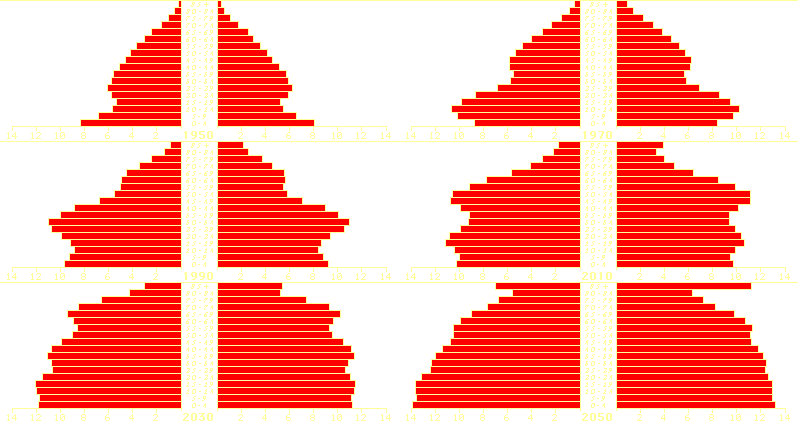
Source: http://data.un.org/
You can find some interesting charts showing age pyramids for multi-country regionshere. You can search for other countries or regions, as well.
What Does It Mean?
What does all this mean?
Well, initially, it means that - in addition to everything else they have going for them - 2 of the BRIC countries (Brazil and India) have much more favorable demographics than the United States. So they are at a competitive advantage to America for demographic reasons in addition to the other reasons that people write about.
Indeed, as Richard Jackson told the White House Conference on Aging in 2005:
Moreover, Dent and another of the main writers focusing on the economic effect of age demographers - Daniel Arnold - say that America's aging demographics point to a major depression.If demography is destiny, global leadership may pass to the “Third” world...
Countries with slowly growing workforces may have slowly growing economies...
We live in an era defined by many challenges, from global warming to global terrorism.
None is as certain as global aging.
And none is likely to have such a large and enduring effect on the shape of national economies and the world order.
As Arnold writes:
2008 was the victim of a self inflicted sub-prime financial crisis. This has nothing to do with the demographics based massive depression that is yet to come, as described in the book. The sub-prime consequences are however very similar though mild so far compared to what is coming our way. The book clearly spelled out that along the way unpredictable short-term (1 to 3 years) disruptive events could happen. The sub-prime crisis is just that. It should be regarded as the “warmer upper” or “hors d'oeuvre” for the big one that is now rapidly closing in on us all.
Subscribe to:
Posts (Atom)